Pillion
Pillion is not a romanticized view of kink, but a raw portrayal of two flawed men navigating power, control, and emotional limits—showing not what an ideal dynamic looks like, but what happens when it begins to break.


Disclaimer: This post contains spoilers about Pillion. If you’d rather experience the film without context, come back once you’ve seen it.
After returning from Darklands, I finally sat down to watch what had quickly become one of the most talked-about films within the gay kink community: Pillion.
There was a certain tension going into Pillion. Not because of what it might show, but because of how it would choose to show it. I was wary of the cringe factor—of seeing kink reduced to surface aesthetics, or, worse, presented in a way that misrepresents what BDSM dynamics actually are.
What I found instead was something far more uncomfortable, far more accurate, and far more interesting.
The Expectations We Bring With Us
My first concern was almost predictable. I feared Pillion would be a repackaged Fifty Shades of Grey for a gay audience, presenting a sanitized, romanticized version of BDSM—and that it would turn collars and keys into aesthetic accessories for gays, worn as symbols of a diluted, vanilla romance, much like the padlocks couples leave on bridges.
Fortunately, that expectation dissolved fairly quickly.
The film makes no attempt to present an idealized or romantic version of a kink relationship. It does not soften the edges, nor does it attempt to translate power into something palatable for a wider audience. If anything, it leans in the opposite direction, showing a dynamic that is neither aspirational nor particularly healthy, but undeniably real in its emotional consequences.
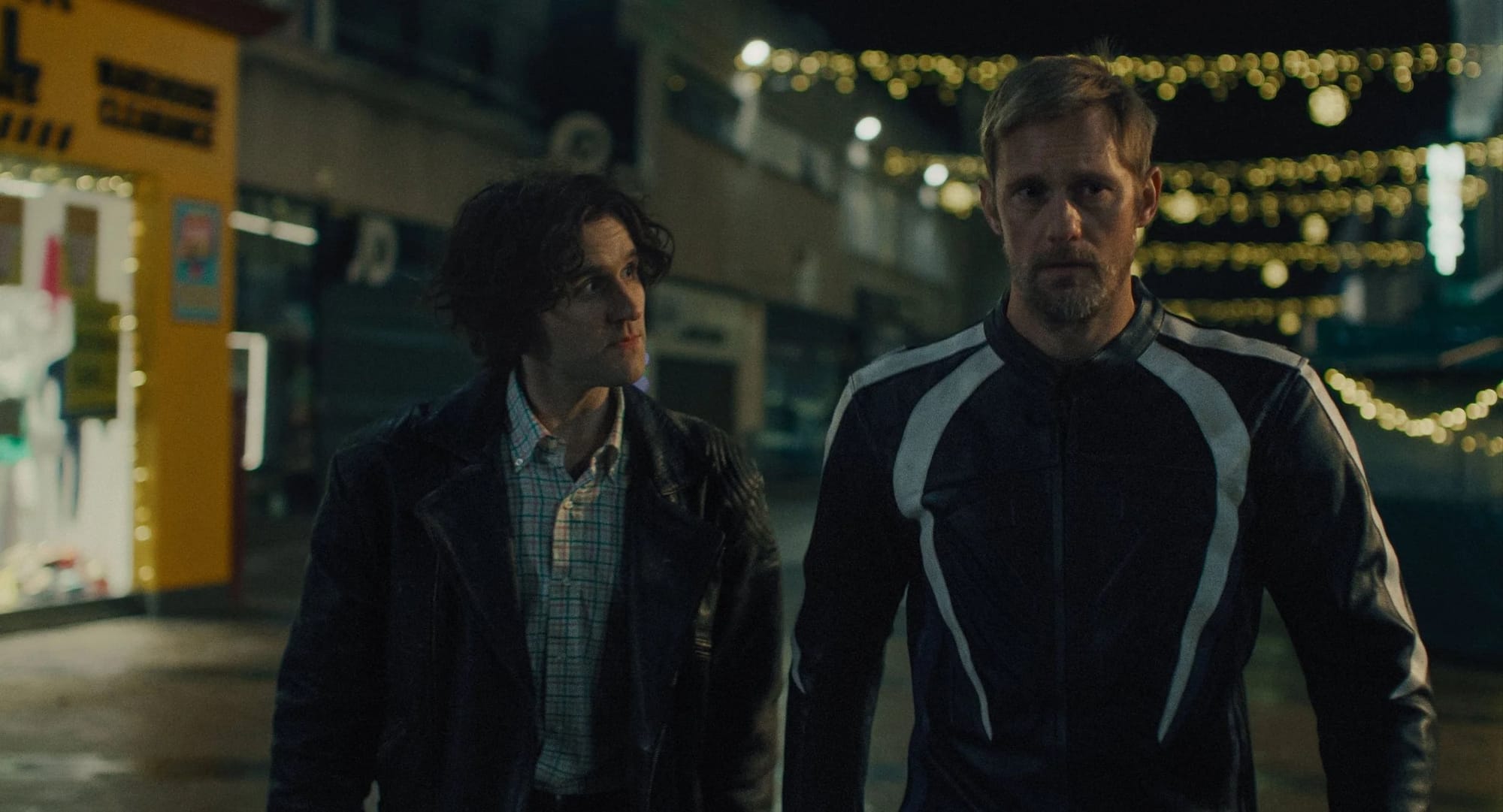
My second concern was more personal. I was wary that Ray, the Dominant portrayed by Alexander Skarsgård, would be reduced to the familiar caricature: a sadistic, emotionally detached figure, defined only by his capacity to exert control.
This is a fear that many Dominants are quietly familiar with. While submissives often worry about being perceived as weak or lacking dignity, Dominants are frequently cast as something almost inhuman—predatory, reckless, incapable of empathy.
Ray, to the casual observer, may seem to confirm that fear. His behavior is cold and his interactions often stripped of any visible warmth. But beneath that exterior lies something far more complex: not a tyrant devoid of humanity, but a man who is clearly broken, most likely by a previous relationship he has never fully recovered from.
Ray and Colin: Two Imperfect Constructions
What Pillion does particularly well is resist the temptation to present a polished or idealized pairing. Instead, it offers two individuals who are deeply flawed, each bringing their own limitations and unmet needs into the dynamic.
Ray
Ray is, in many ways, a Dominant who has lost his ability to engage emotionally. There is a sense that he has mastered how to exercise authority, but not how to truly engage with another person within it. His distance is a defense mechanism.
Many Dominants, at some point in their development, come to rely on a façade of invulnerability. They present themselves as composed, self-contained, and unaffected by the emotional currents that inevitably run through any meaningful dynamic. This may work for some time, creating a sense of stability and control, both for themselves and for those who submit to them.
But over time, that façade takes its toll. When that structure collapses –and trust me, it eventually does– the collapse is rarely contained, unraveling not only the dynamic but the man behind it.
It would be a mistake, however, to read Ray as someone who is completely indifferent to Colin’s desires or emotional responses. There are moments in the film where a different layer of his dominance becomes visible. During a camping event with other bikers, there is a scene where several submissives are presented, positioned and waiting to be used. Ray approaches Colin at first, but instead of choosing him, he deliberately turns to another sub beside him and begins with him.
At one point, he shifts his attention back to Colin, leaving the other sub, to use Colin. The gesture makes the message unmistakable: I could take any of them, but I chose you. When he does, the moment carries a different weight. For Colin, it becomes one of the defining moments of their dynamic—not because of what is done, but because of what it signifies: I am his.
Colin
Colin, by contrast, enters the story from a position of openness that borders on naivety. He is young, inexperienced, and entirely unformed within the context of kink. His lack of knowledge is not accompanied by hesitation; instead, it manifests as a willingness to accept, adapt, and align himself with whatever is placed in front of him.
There is something in Colin that suggests a natural inclination toward submission. Not in the superficial sense of obedience, but in a deeper orientation toward structure, purpose, and belonging. He appears to find meaning in being directed, in being useful, in being shaped by another.
However, that same openness leaves him exposed. He enters the dynamic without an understanding of limits, negotiation, or self-definition. It prevents him from engaging in the dynamic in a healthy way, where service can lead to something fulfilling and sustainable over time.
How People Will Perceive The Film
One of the most interesting aspects of Pillion is how differently it will be perceived depending on the viewer’s understanding of kink dynamics.
There are moments in the film that, to an external audience, will register as unnecessarily awkward or even abusive. When Ray invites Colin into his home and immediately places him in a subordinate role—asking him to cook, placing his dog at the sofa while Colin stands, ignoring him while he eats, directing his attention instead toward the TV and his dog—the scene can easily be perceived as dismissive or degrading.
Similarly, the decision to have Colin sleep on the carpet, with the implicit threat of being sent to the corridor if he makes noise and wakes Ray, is likely to provoke discomfort in those unfamiliar with the underlying framework.
What is less visible to that audience is the function of these interactions.
Ray is testing Colin. He is observing how he responds to commands, humiliation, and power exchange, how far he is willing to go, and whether his submission is genuine. These are not negotiations in the conventional sense, but they are nonetheless part of a process of evaluation.
This does not necessarily make the dynamic healthy (there's no discussion about limits, safe words, etc), nor does the film attempt to argue that it is. But it does reflect a reality that is often misunderstood: that power exchange, particularly in its more total forms, is not always immediately articulated through explicit agreements. It can emerge through interaction, through response, through the gradual recognition of compatibility—or the lack of it.
Breaking Points and What They Reveal
As the film progresses, both characters are pushed toward their respective breaking points.
Colin’s breaking is direct and visceral. His inability to process emotional pain after his mother’s death, in the absence of support, leads him toward self-inflicted harm—not as spectacle, but as a desperate attempt to reach the emotional support of the person he is devoting himself to. It exposes the cost of a dynamic where hierarchy exists without care.
There's nothing subtle with Ray’s breaking either. It comes at the end of the film, after he grants Colin a “day off,” allowing him to step outside the dynamic and experience something closer to a conventional emotional connection. What follows during that day already feels slightly out of place, as if both of them are navigating unfamiliar territory, but the real shift happens in a field.
What begins as a playful interaction escalates into something else when Colin ends up on top of Ray and they lock eyes. In that moment, something breaks. It is visible, almost physical, in Ray’s expression. What he is confronted with is not submission, not control, but emotional intimacy—something he is clearly unable to process.
Ray disappears, abandons the house, and removes himself from Colin’s life without explanation. When Colin returns, there is nothing left—an empty space, no answers, and no trace of where Ray has gone. Even those around them seem unaware of his whereabouts.
One alternative interpretation would be that Ray, faced with Colin’s need for emotional connection, chooses to give him one final “gift”—a day outside the dynamic—before deliberately ending the relationship and walking away.
But that reading does not hold up. It does not make sense that he would dismantle his entire life as part of this calculated gesture. If his intention had been to end things, he could have done so directly, maintaining control even in separation.
A Positive Resolution
Despite the tension and fragmentation that define much of the film, its conclusion carries a sense of progression. Colin begins to develop a clearer sense of himself, establishing limits and understanding the needs he has within a BDSM relationship—what he requires in order to devote himself in a way that is both meaningful and sustainable.
Another positive aspect of the film is how it portrays the kink community as a supportive one. These dynamics do not exist in isolation, and the film subtly shows a network of individuals who understand, observe, and provide continuity beyond any single relationship.
Final Reflections
Pillion does not attempt to present an ideal model of a BDSM relationship, and it is better for it.
What it offers instead is a portrayal of power, vulnerability, and human limitation that feels grounded, even when it is uncomfortable to watch. It presents the characters as they are—complex, flawed, and shaped by forces they do not fully understand.